Unit 104 Unit 104
Arid transition country east of the Rubies — antelope-first, with a surprisingly strong elk hunt.
Northeastern Nevada — Elko / White Pine County line (NDOW Units 101-109) · Last reviewed 2026-07-12
Area
1,332
sq mi
Public land
90%
approx.
Elevation
6,000–9,100
feet
Motorized
extensive
access
Overview
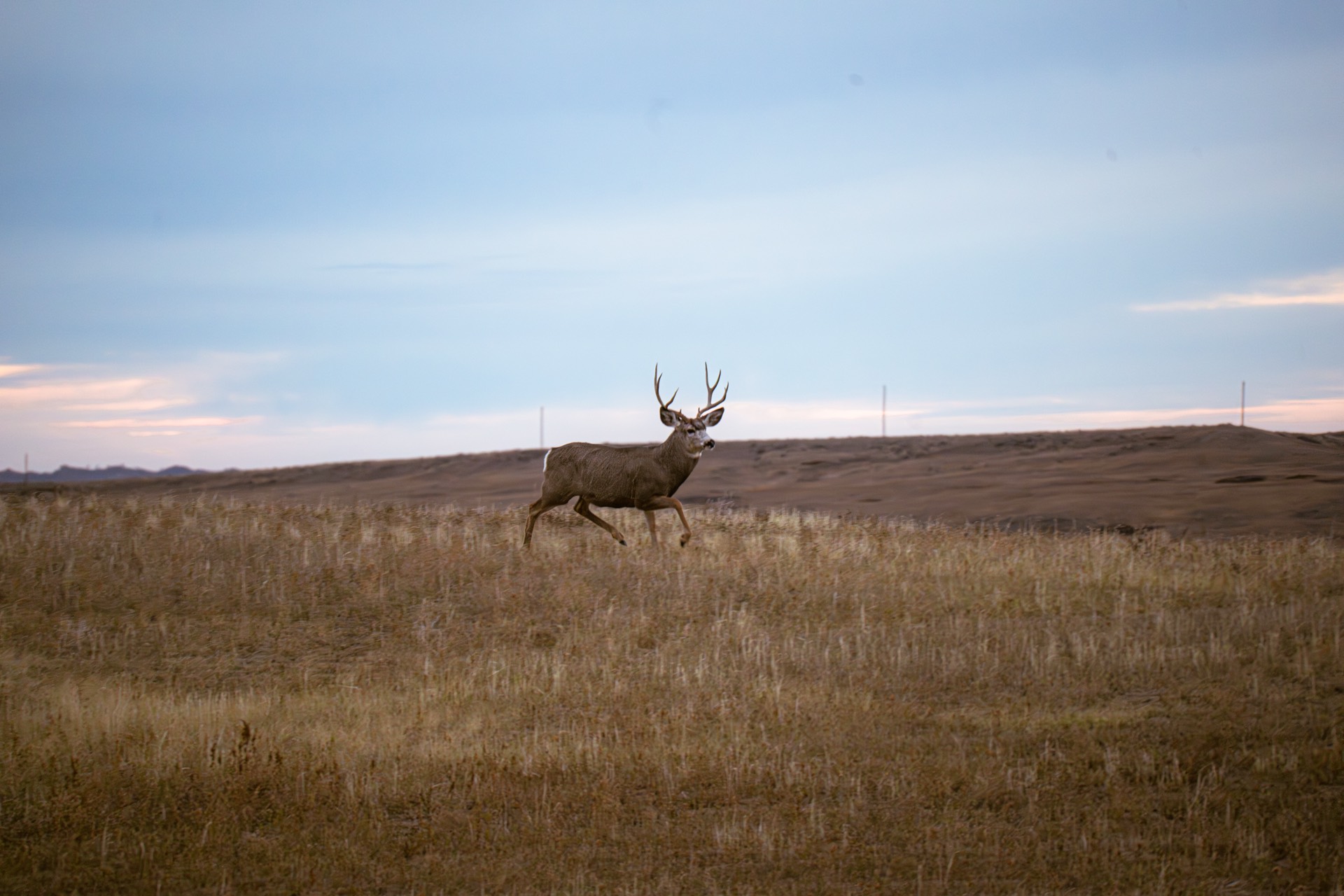
Unit 104 is the dry, open eastern flank of the hunt group, taking in the Medicine Range, Maverick Springs Range and the Butte Mountains between Ruby Valley and Butte Valley along the Elko-White Pine county line. Unlike the alpine Rubies to the west, this is a transition and winter range — heavier pinyon-juniper, lower deer density, but excellent access. Pronghorn lead the harvest and post the unit's best odds (~73%), and elk here hunt above their weight with roughly 60% success. Deer are present but this is antelope-and-elk country first.
Terrain
Broad Great Basin valleys and low-to-mid desert ranges rather than high alpine — sagebrush flats broken by tree-covered hills and mahogany pockets. High Baldy of the Medicine Range tops out near 9,100 ft; the lower west edge sits around 6,000 ft. More arid and gentler than the Rubies, with expansive glassing country.
Cover: Sagebrush dominates the flats and lower slopes, with areas of dense pinyon-juniper on the ranges and small pockets of mountain mahogany and quaking aspen at the higher, moister sites. The juniper gives deer heavier cover than the open Rubies.
Landmarks: Medicine Range (High Baldy ~9,100 ft) · Maverick Springs Range · Butte Mountains · Ruby Valley (west) / Butte Valley (east) · Ruby Wash Road (north) · US Highway 50 (south)
Access
Access is excellent via a broad network of maintained county and BLM roads. White Pine County Road 3 and Ruby Valley Road reach the western parts; Ruby Wash Road serves the north; Butte Valley Road and White Pine County Roads 19 and 17 open the eastern reaches; US Highway 50 anchors the south. Public land dominates, though the west edge borders Ruby Valley ranchland and the closed Ruby Lake National Wildlife Refuge.
Managers: BLM, USFS Humboldt-Toiyabe NF
Access points: Ruby Valley Road / White Pine County Road 3 (west) · Ruby Wash Road (north) · Butte Valley Road (east) · White Pine County Roads 17 & 19 (east) · US Highway 50 (south)
Species notes
Pronghorn
common qualityAntelope are the signature big game here, leading the unit's harvest and posting its best success (~73%). The open sagebrush valleys of Ruby and Butte Valleys hold good numbers, and a limited-draw tag on a located buck is usually a good one.
- →Glass the wide sagebrush flats of Ruby and Butte Valleys from high points early and late.
- →Key on water sources and green valley edges during warm early seasons — antelope pattern to reliable water.
- →Use the broad road network to cover ground and glass multiple basins, then stalk through swales and folds.
- →Judge bucks carefully in this open country where you can watch them for a long time before committing.
Rocky Mountain Elk
limited qualityElk hunt better than the unit's reputation, with the group's strongest success (~60%). Bulls use the timbered Medicine, Maverick Springs and Butte ranges and their mahogany-aspen pockets. A limited tag here can be a genuinely productive elk hunt.
- →Work the pinyon-juniper and mahogany-aspen benches of the Medicine and Butte ranges at dawn and dusk.
- →Locate on bugles during the rut, then still-hunt the tree cover and glass the openings.
- →Focus on water and higher, moister north slopes where elk concentrate in dry country.
- →Use the good road access to scout multiple ranges and pattern herds before the season.
Mule Deer
common opportunityThis is transition and winter range with a resident herd rather than a high-density deer unit — success (~35%) and densities run below the alpine Rubies. Heavier juniper cover and easy access make it a solid opportunity hunt more than a trophy destination.
- →Hunt the pinyon-juniper edges and mahogany pockets where resident deer hold cover.
- →Glass the transition between sagebrush flats and treed slopes at first and last light.
- →Later in the season, watch for deer moving in off the higher units onto this winter range.
- →Cover country with the road network, then hunt into draws out of sight of vehicles.
Pro tips
- →Play to the unit's strengths — antelope and elk are the real opportunities here, not high-density deer.
- →Elk success (~60%) is the best in the group; a tag in the Medicine or Butte ranges is worth taking seriously.
- →Use the excellent road network to glass multiple valleys and ranges in a day, then commit to the best concentration.
- →In this arid country, find the water and you find the game — map springs and stock tanks before you go.
- →Come fully self-sufficient: no services, no cell coverage, long distances between towns.
Watch out for
- !Remote and services-free — fuel up in Elko or Ely and carry extra water and recovery gear.
- !No cell coverage across the unit; a satellite communicator is essential.
- !Valley and range roads become slick and impassable after rain or snow.
- !The western boundary borders Ruby Valley private ranchland — verify access before crossing.
- !Ruby Lake National Wildlife Refuge on the west edge is closed to big-game hunting.
Logistics
Elko to the north and Ely to the south (with Eureka to the southwest) provide fuel, groceries, lodging and RV parks and are the practical staging points; the unit itself is remote with no services. Dispersed camping is readily available on the surrounding BLM and USFS land. Cell service is essentially absent across the valleys and ranges — carry a satellite communicator and plenty of fuel and water.
Nearest towns: Elko, Ely, Eureka, Spring Creek
Seasons & regulations
This page carries no season dates or regulations. Get current rules from the official Nevada sources:
Research sources: NDOW Mule Deer Units 101-109 Hunt Information Sheet · NDOW Hunt Unit Boundaries · Nevada Unit 104 profile — Medicine/Maverick Springs/Butte ranges (cross-check)
FAQ
- How big is Unit 104 in Nevada?
- Unit 104 (Unit 104) covers about 1,332 square miles, ranging from roughly 6,000 to 9,100 feet in elevation. Area is computed from the unit boundary polygon.
- How much public land is in Unit 104?
- Approximately 90% of the unit is public land. Primary managers: BLM, USFS Humboldt-Toiyabe NF. Always verify ownership boundaries on the ground.
- What species does the catalog list for Unit 104?
- Pronghorn, Rocky Mountain Elk, Mule Deer. For seasons, tags, and regulations, use the official Nevada agency resources linked on this page — this page carries no regulatory information.
Put Unit 104 on your map.
Boundary lines, public/private ownership, topo, and offline maps for this unit — in Baseline Maps, free for 14 days.