Unit 106 Unit 106
Big, arid Goshute-Dolly Varden country — good access, thin game
Eastern Nevada — Elko and White Pine Counties · Last reviewed 2026-07-12
Area
1,446
sq mi
Public land
92%
approx.
Elevation
5,600–9,700
feet
Motorized
extensive
access
Overview
Unit 106 is a large, arid block of eastern Nevada southeast of Wells, taking in the Goshute Mountains, the Dolly Varden Mountains, and the Antelope Range along the Elko-White Pine county line. It is the low-density corner of its elk group — NDOW notes elk numbers are low and harvest is very little, so success comes from finding the small pockets of quality habitat scattered through the ranges. Mule deer occur only as a thin resident herd on transition and winter range, while a small band of antelope holds in the valleys. The upside is access: NDOW rates it excellent, with an extensive road network and very little private land.
Terrain
Widely spaced desert ranges — the Goshute, Dolly Varden, and Antelope mountains — separated by broad sagebrush valleys, all of it arid with limited natural water and numerous wildlife water developments. Game concentrates in the isolated pockets of the ranges that still carry good forage; the valleys hold antelope.
Cover: Wyoming big sagebrush basins rising into extensive pinyon-juniper woodland, with limited mountain mahogany and aspen and meadow stringers near the higher springs. Wild-horse overuse has degraded forage across much of the unit, leaving quality habitat patchy.
Landmarks: Goshute Mountains · Dolly Varden Mountains · Antelope Range · Goshute Valley · Antelope Valley · Spruce Mountain Ridge (west) · U.S. 93 · U.S. 93A
Access
Overwhelmingly public BLM land (Elko and Ely districts) with an extensive road network and very little private land — NDOW rates access excellent. Reach the ranges from U.S. 93 and U.S. 93A between Wells and Ely, then follow graded and two-track BLM roads into the Goshute, Dolly Varden, and Antelope mountains. The unit is large, so plan for long drives between the widely separated ranges.
Managers: BLM
Access points: U.S. 93 · U.S. 93A · Goshute Valley roads · Antelope Valley roads · BLM range roads
Species notes
Rocky Mountain Elk
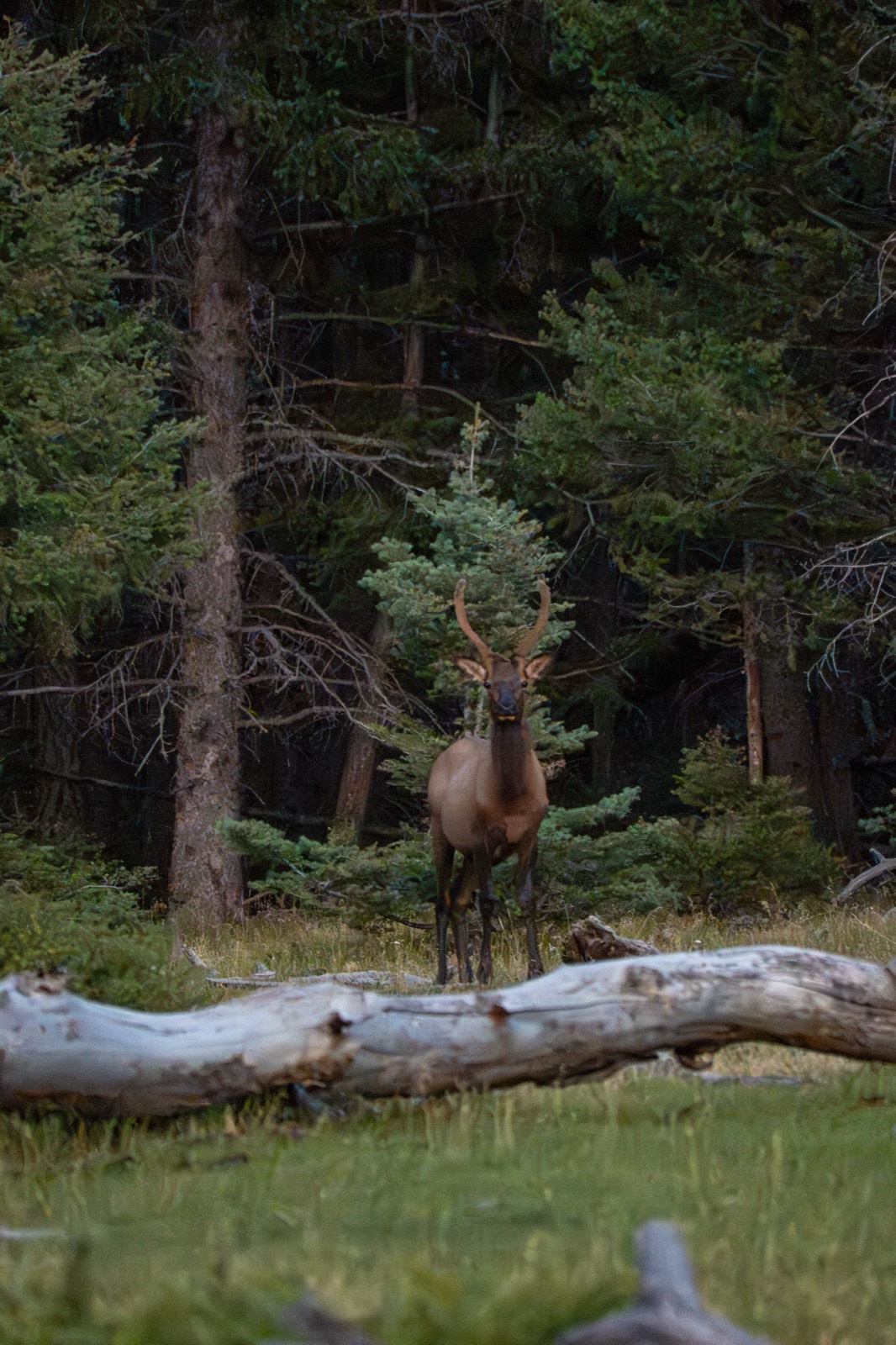
limited opportunityLow elk densities and very little harvest — NDOW's guidance is to hunt the small pockets of quality habitat in the Goshute, Dolly Varden, and Antelope ranges. Recent group-wide bull success runs near 48%, but tag numbers and elk numbers here are both modest. This is a boots-and-glass hunt for scattered animals.
- →Scout for the isolated habitat pockets in the Goshute, Dolly Varden, and Antelope mountains that still hold good forage after wild-horse impacts.
- →Key on the guzzlers and springs early — natural water is scarce and elk pattern to it in the arid basins.
- →Cover ground with optics between ranges; elk are thin and widely scattered, so glassing volume finds them.
- →Hunt the high, brushy canyon heads away from roads where the few resident bulls hold once pressured.
Mule Deer
limited opportunityA small resident herd only — like the rest of Units 104-109, this ground is mainly transition and winter range for more productive units, with low densities and heavy pinyon-juniper cover. Recent group success runs near 35%. Time behind glass, not deer numbers, drives the outcome.
- →Grind glass over mahogany stands and sage benches on the upper slopes of the ranges.
- →Hunt away from vehicle access — deer slip a canyon back from the roads once the season opens.
- →Work close to reliable springs and guzzlers early, then the higher tables as weather cools.
Pronghorn
limited opportunityA small band of antelope holds in the Goshute and Antelope valleys. Tags are few, but recent draw success has been very high (near 88%) — a high-odds hunt on a small, water-tied population.
- →Glass the open sage flats of Goshute and Antelope valleys at first and last light.
- →In the hot early season, hunt the water — antelope tie to springs and stock tanks through August-September.
- →Judge bucks from long range on a tripod, then use terrain folds to close in the open country.
Pro tips
- →Treat this as a low-density elk unit — success is about finding the few good habitat pockets, not covering the whole range.
- →Scout the guzzlers and springs before opening day; in this arid unit water is the single biggest pattern.
- →Budget for long drives — the Goshute, Dolly Varden, and Antelope ranges are widely separated across a very large unit.
- →Seek out the mountainsides that escaped the worst wild-horse forage damage.
- →Excellent access is the trade-off for thin game — use the road network to glass a lot of country efficiently.
Watch out for
- !Very little natural water — plan to haul your own drinking water and expect game to bunch on the few sources.
- !Wild horses have overutilized much of the unit, leaving forage and game patchy; scout the better pockets.
- !Limited to no cell service off the highways; carry a satellite communicator and leave an itinerary.
- !The unit is very large with long distances between ranges — manage fuel and time deliberately.
- !Early snow can make the upper range roads greasy and strand a rig without 4WD and recovery gear.
Logistics
Stage out of Wells or Ely on U.S. 93 for fuel, groceries, motels, and RV parks; Wendover and Elko add fuller services. There are no developed campgrounds inside the unit — dispersed camping on BLM land is standard, typically near tree cover or a reliable spring. Haul in drinking water; natural water is scarce across the whole unit. Cell service is limited to nonexistent away from the highway corridors, so carry a satellite messenger. Given the unit's size and the distance between ranges, plan fuel and mileage carefully; 4WD helps on the upper two-tracks and after storms.
Nearest towns: Wells, NV, Ely, NV, Wendover, NV, Elko, NV
Seasons & regulations
This page carries no season dates or regulations. Get current rules from the official Nevada sources:
Research sources: NDOW Elk Hunt Info Sheet — Units 078, 105-107, 109 · NDOW Mule Deer Hunt Info Sheet — Units 101-109 · GoHunt Nevada Unit 106 Profile (secondary cross-check)
FAQ
- How big is Unit 106 in Nevada?
- Unit 106 (Unit 106) covers about 1,446 square miles, ranging from roughly 5,600 to 9,700 feet in elevation. Area is computed from the unit boundary polygon.
- How much public land is in Unit 106?
- Approximately 92% of the unit is public land. Primary managers: BLM. Always verify ownership boundaries on the ground.
- What species does the catalog list for Unit 106?
- Rocky Mountain Elk, Mule Deer, Pronghorn. For seasons, tags, and regulations, use the official Nevada agency resources linked on this page — this page carries no regulatory information.
Put Unit 106 on your map.
Boundary lines, public/private ownership, topo, and offline maps for this unit — in Baseline Maps, free for 14 days.