Unit 70 Beatys Butte
Vast SE Oregon high-desert pronghorn country wrapped around Hart Mountain and Beatys Butte.
East Oregon — Southeast high desert · Last reviewed 2026-06-03
Area
2,632
sq mi
Public land
82%
approx.
Elevation
4,300–7,918
feet
Motorized
moderate
access
Overview
Unit 70 (Beatys Butte) is a roughly 2,600-square-mile slice of Oregon's remote southeastern high desert, anchored by Hart Mountain National Antelope Refuge on the west and the namesake Beatys Butte to the east. The country is overwhelmingly public — about 82% BLM rangeland and refuge land — so legal access is rarely the limiting factor, but it is genuinely big, dry, and far from services. It is best known as classic pronghorn country, with mule deer, a fragile California bighorn herd centered on Hart Mountain, a general fall black bear season, sparse desert elk, and free-roaming wild horses sharing the sage flats.
Terrain
Mostly flat-to-rolling high-desert basins broken by bluffs, buttes, rims and canyons. The west edge rises abruptly along the Hart Mountain fault scarp; Coleman Rim (which runs south into Nevada) and the Guano Rim country add steep relief, and the terrain steepens noticeably around isolated Beatys Butte itself, whose summit tops out near 7,918 feet. Broad valleys, dry lakebeds and playas separate the higher ground.
Cover: Great Basin sagebrush-steppe: big sagebrush and bunchgrass on the flats, low sagebrush on the ridges, with scattered western juniper, mountain mahogany and aspen pockets at higher elevations and around springs. Very dry country, averaging only about 9 inches of precipitation a year, mostly winter snow.
Landmarks: Hart Mountain National Antelope Refuge · Beatys Butte · Coleman Rim · Guano Rim / Guano Valley · Hart Mountain fault scarp · Catlow Valley (northeast edge) · Warner Valley / Plush (west) · Beaty Butte Wild Horse Herd Management Area
Access
ODFW lists the unit at about 82% public, dominated by BLM rangeland plus the Hart Mountain refuge complex, so legal access is rarely the limiting factor — distance and road conditions are. Note that the standard general Unit 70 big-game hunts do NOT include the Hart Mountain refuge; the refuge has its own controlled tags, and weapon types are restricted there (general-weapon for pronghorn, archery/muzzleloader only for mule deer). Motorized travel is limited to designated/open roads, and several refuge research natural areas are closed to vehicles entirely. Private inholdings and ranch bottoms require permission; gravel and dirt roads make up nearly all travel.
Managers: BLM (Lakeview & Burns districts), USFWS - Hart Mountain National Antelope Refuge, Private high-desert ranches (scattered inholdings & valley bottoms)
Access points: Hart Mountain refuge road from Plush (west) via Warner Valley · Frenchglen / Catlow Valley approach from the northeast · County roads off Highway 205 (Frenchglen-Fields corridor) · Adel / Highway 140 approach to the southwest · BLM backcountry roads radiating toward Beaty Butte from the Hart Mountain road
Species notes
Pronghorn
common qualityThe signature game animal of Unit 70. Beatys Butte is one of Oregon's better-known pronghorn units, and the Hart Mountain refuge in particular has a reputation for producing big bucks — but the refuge hunts are separate controlled tags and are notoriously hard to draw. The general off-refuge BLM hunts cover the bulk of the unit on largely public ground and offer solid opportunity rather than guaranteed trophies.
- →Glass from rims, buttes and rises at first and last light — locate bucks at distance, then close the gap across open sage
- →Hunt water and green where it exists in a dry year: springs, stock tanks, wet meadows and seep lines concentrate animals
- →Drawn Hart Mountain refuge bucks tend to average larger; the general off-refuge BLM ground holds more animals but generally lighter horn
- →Plan long stalks across flat-to-rolling ground using terrain folds, rims and dry washes for cover
- →Pre-season scouting is decisive — learn which basins and water sources are holding goats before the opener
Mule Deer
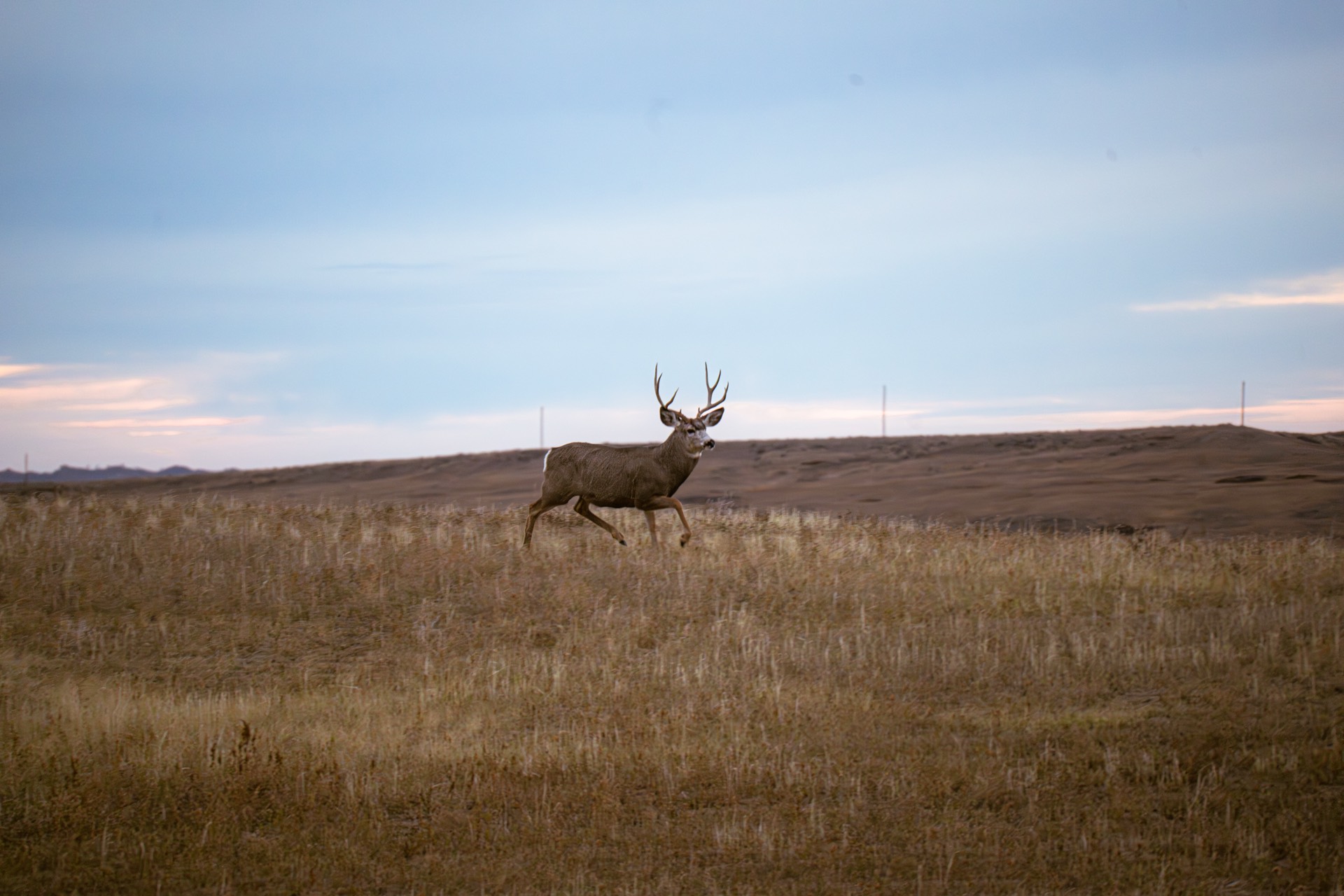
common opportunityMule deer are present unit-wide on a controlled-hunt basis. The unit still kicks out occasional good bucks, but trophy-class deer are 'not as common as in years past.' This is an opportunity-grade deer unit rather than a destination trophy unit.
- →Work the rough country — the Hart Mountain scarp, Coleman/Guano rims and the broken ground around Beatys Butte hold the better bucks
- →Glass juniper fringes, mahogany pockets, aspen draws and rimrock benches at dawn and dusk
- →Higher, brushier elevation bands hold deer early; deer shift with weather and feed availability through the season
- →On the Hart Mountain refuge, mule deer tags are archery/muzzleloader only — plan for close-range, low-pressure hunting
- →Be mobile and cover ground; deer density is low and spread across a huge area
Bighorn Sheep
limited qualityCalifornia bighorn occur on and around Hart Mountain, where a once-strong herd has crashed — USFWS counts fell about 67%, from 149 sheep in 2017 to 48 in 2020, driven by cougar predation and habitat decline. This is a true once-in-a-lifetime, extremely low-odds draw, and given the depressed, conservation-sensitive herd, tags may be limited or unavailable in any given year.
- →Hunt the steep rimrock, talus and canyon breaks of the Hart Mountain scarp where sheep hold
- →Spend days glassing rims and bluffs from below — sheep here are few and scattered
- →Treat any drawn tag as a multi-week, boots-and-optics campaign with refuge biologist coordination
- →Expect a long, low-density search given the depressed herd numbers
Black Bear
limited opportunityBlack bears are present at low density across the rimrock, juniper and mahogany pockets of the higher country. ODFW offers a general fall black bear season here (a modest number of tags) plus spring controlled opportunity, making bear one of the few non-draw options in the unit — though encounters are uncommon in this open desert landscape.
- →Focus on the higher, brushier ground — juniper and mahogany fringes near the Hart Mountain scarp, Coleman Rim and Beatys Butte
- →Glass mahogany and aspen pockets and rimrock benches at dawn and dusk
- →Hunt near water and seasonal food sources; bears here range widely and are thinly distributed
- →Often taken incidentally by deer or pronghorn hunters who catch a bear in the open
Rocky Mountain Elk
transient lowElk are a marginal, transient presence in Unit 70 — ODFW maintains an elk hunt series, but this desert unit holds few elk, they move broadly, and they are protected on the Hart Mountain refuge. Treat elk as an opportunistic, low-density proposition rather than a reason to choose this unit.
- →Concentrate on the higher juniper/mahogany country and water sources where the occasional band loiters
- →Glass big from rims and buttes; small scattered groups can be miles apart
- →Be prepared to cover enormous ground for low odds of contact
- →Pair elk effort with deer or pronghorn scouting rather than hunting elk as the primary goal
Cougar
limited opportunityCougars range throughout the rimrock and canyon country following the deer and pronghorn herds, and cougar predation has been a major factor in the Hart Mountain bighorn decline. Densities are still low across this open desert unit, and cats are typically taken incidentally or by hunters specifically targeting fresh sign.
- →Cut tracks and follow sign in snow along rims, canyon bottoms and around deer concentrations
- →Focus on broken terrain near the Hart Mountain scarp, Coleman Rim and Beatys Butte where deer hold
- →Glass rimrock and predator-call in canyon country during winter
- →Treat as an opportunistic add-on to a deer or winter scouting trip
Pro tips
- →Scout hard before the opener — in dry years, knowing which springs, tanks and meadows hold water (and game) is worth more than any other intel
- →Know which animal you're hunting on which ground: the general Unit 70 hunts exclude the Hart Mountain refuge, and refuge tags carry their own weapon restrictions (general-weapon pronghorn, archery/muzzleloader-only mule deer)
- →Glass from elevation — rims, buttes and the fault scarp let you cover enormous country and spot pronghorn and deer at distance
- →Carry two full-size spares; sharp basalt and miles of rough road shred tires far from any help
- →Don't ignore the bonus opportunity — a general fall black bear season, plus chukar, quail and wild horses, make for memorable backcountry days
Watch out for
- !Extreme remoteness — no cell service, long distances between fuel/water, and self-rescue is the norm if something breaks
- !Roads become impassable mud after rain or snow; a passing front can trap vehicles for days
- !Refuge rules differ from the surrounding BLM, and most general Unit 70 hunts exclude the Hart Mountain refuge entirely — verify whether your tag is valid on refuge ground
- !Private inholdings and ranch bottoms within the public matrix require permission — verify boundaries with a current map/GPS layer
- !Bighorn numbers on Hart Mountain are badly depressed (a ~67% decline, conservation-sensitive); this is a near-zero-odds tag, not a reliable hunt
- !Most big game (deer, pronghorn, sheep) is controlled-tag (draw) only — plan for point accumulation; the general fall black bear season is the main non-draw exception
Logistics
This is some of the most remote country in the Lower 48 — services are minimal and far apart. Tiny Plush and Adel offer little; fuel, lodging and full supplies are realistically in Lakeview (southwest), Burns/Hines (north) or Frenchglen. Cell coverage is essentially absent across most of the unit. Nearly all travel is on gravel and dirt; carry extra fuel, water, food, and at least one (ideally two) full-size spare tires, plus recovery gear. A high-clearance 4WD is strongly recommended, and roads turn to greasy, impassable mud after rain or snow. Tell someone your plan and expect to be self-sufficient for days.
Nearest towns: Plush, OR, Adel, OR, Frenchglen, OR, Lakeview, OR, Fields, OR, Burns / Hines, OR
Seasons & regulations
This page carries no season dates or regulations. Get current rules from the official Oregon sources:
Research sources: ODFW - Beatys Butte Unit 70 · GoHunt - Oregon Unit 70 Beatys Butte Profile · BLM - Beaty Butte Herd Management Area · USFWS - Hart Mountain Final Bighorn Sheep Management Plan & EIS (2017-2020 decline) · Peakbagger - Beatys Butte, Oregon (7,918 ft)
FAQ
- How big is Unit 70 in Oregon?
- Unit 70 (Beatys Butte) covers about 2,632 square miles, ranging from roughly 4,300 to 7,918 feet in elevation. Area is computed from the unit boundary polygon.
- How much public land is in Unit 70?
- Approximately 82% of the unit is public land. Primary managers: BLM (Lakeview & Burns districts), USFWS - Hart Mountain National Antelope Refuge, Private high-desert ranches (scattered inholdings & valley bottoms). Always verify ownership boundaries on the ground.
- What species does the catalog list for Unit 70?
- Pronghorn, Mule Deer, Bighorn Sheep, Black Bear, Rocky Mountain Elk, Cougar. For seasons, tags, and regulations, use the official Oregon agency resources linked on this page — this page carries no regulatory information.
Put Unit 70 on your map.
Boundary lines, public/private ownership, topo, and offline maps for this unit — in Baseline Maps, free for 14 days.