GMU 82 GMU 82 — Alamosa/Saguache Co.
Valley-floor pronghorn and Sangre de Cristo elk under the Great Sand Dunes
South-central Colorado — eastern San Luis Valley / Sangre de Cristo west slope · Last reviewed 2026-07-12
Area
1,092
sq mi
Public land
55%
approx.
Elevation
7,500–13,000
feet
Motorized
moderate
access
Overview
GMU 82 covers the northeastern San Luis Valley and the west flank of the Sangre de Cristo Mountains, running from Poncha Pass south to US 160 near Alamosa and taking in the Great Sand Dunes and the Sangre de Cristo Wilderness. It ranges from flat valley sage around 7,500 feet up to rugged peaks past 13,000 feet. Pronghorn is the standout — the valley floor produces the best antelope hunting of the southern-valley units (recent harvest near 90 at ~77% success) — alongside an over-the-counter-pressured elk hunt (about 21% bull success) and a limited-draw mule deer hunt on the mountain front. Note that Great Sand Dunes National Park and Baca National Wildlife Refuge are closed to hunting within the unit.
Terrain
Flat valley floor stepping up abruptly to high mountains. The west and central unit is open San Luis Valley sage, grassland, wetlands, and the sand-sheet around the Great Sand Dunes; the eastern edge rises fast through pinyon-juniper and aspen into the spruce-fir and alpine of the Sangre de Cristo west slope, including the Sangre de Cristo Wilderness.
Cover: Big sagebrush, rabbitbrush, grassland, and greasewood on the valley floor with wet meadows near the Baca; pinyon-juniper and Gambel oak on the mountain-front benches; aspen and spruce-fir climbing to alpine tundra along the Sangre de Cristo crest. Willow and cottonwood along the creeks off the range.
Landmarks: Great Sand Dunes National Park and Preserve · Sangre de Cristo Wilderness · Baca National Wildlife Refuge · Poncha Pass · Blanca Peak massif (to the south) · Medano and Zapata Creeks · San Luis Valley floor
Access
Roughly half public, but access is uneven. Huntable public is concentrated on the Sangre de Cristo west slope — Rio Grande National Forest and the Sangre de Cristo Wilderness — plus the Great Sand Dunes National PRESERVE (the high country above the National Park) and BLM on the valley floor. Great Sand Dunes National PARK and the Baca National Wildlife Refuge are closed to hunting. Much of the valley floor is large private ranch (including former Baca/Nature Conservancy holdings). Colorado State Trust lands are NOT open to hunting unless enrolled in CPW's Public Access Program.
Managers: USFS Rio Grande National Forest (Saguache RD), USFS Sangre de Cristo Wilderness, NPS Great Sand Dunes National Preserve, BLM San Luis Valley Field Office, private ranch
Access points: Great Sand Dunes NP entrance (CO 150) — Preserve access above the Park · Mosca / CO 17 valley corridor · Poncha Pass (US 285) north end · USFS trailheads into the Sangre de Cristo Wilderness (Medano, Zapata) · BLM valley-floor two-tracks
Species notes
Pronghorn
common qualityThe unit's standout — the open San Luis Valley floor produces the best pronghorn of the three southern-valley units, with a recent harvest near 90 and success around 77%. Limited-draw, so points may be required, but a productive, high-success hunt when you draw.
- →Glass the open sage-grassland and greasewood flats of the valley floor; bucks water at valley tanks and wet meadows.
- →Use the flat terrain's subtle folds and irrigation berms to stalk within range.
- →Sort out private-vs-public carefully — much of the floor is large ranch ground and closed refuge; hunt the BLM and enrolled-access parcels.
Rocky Mountain Elk
common opportunityA general over-the-counter-pressured elk hunt on the Sangre de Cristo west slope, with recent bull success around 21%. Elk summer high in the wilderness timber and basins and drop to the mountain front and valley edge as snow builds.
- →Hunt the aspen-conifer edges and high basins of the Sangre de Cristo west slope; get above the road pressure.
- →Glass the mountain-front benches at dawn and dusk where elk feed the openings.
- →Later rifle seasons pull elk down toward the valley edge as high-country snow accumulates.
- →The Great Sand Dunes Preserve high country adds foot-access public ground above the closed Park.
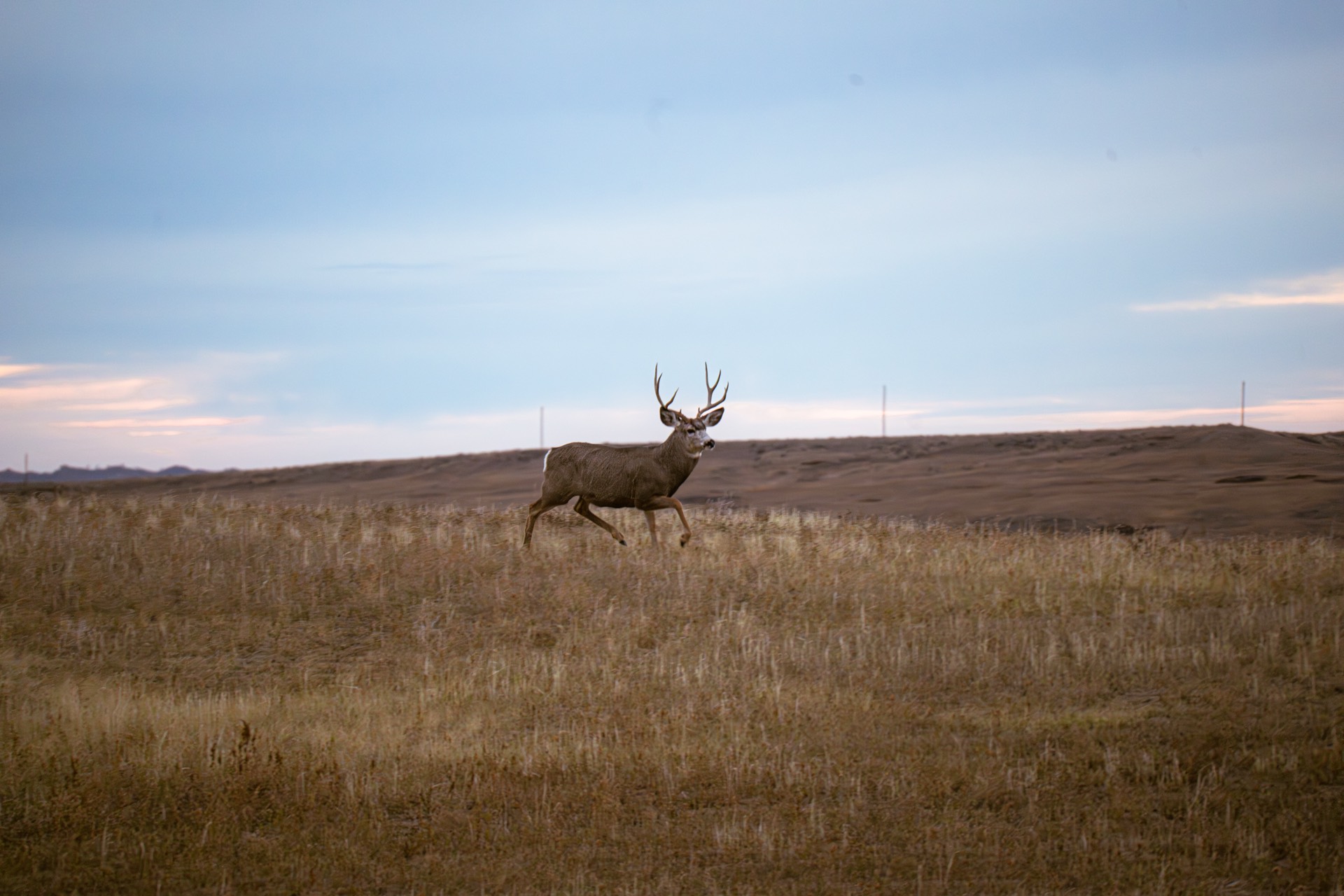
Mule Deer
common qualityA limited-draw mule deer hunt (part of the Sand Dunes deer herd, DAU D-37) with moderate success — recently around 43% of tags filled. Bucks hold on the oak-brush and pinyon-juniper benches of the mountain front and the aspen edges higher up.
- →Grid-glass the pinyon-juniper and oak-brush benches along the Sangre de Cristo front.
- →Work aspen and mountain-shrub edges in the transition zone morning and evening.
- →Later hunts concentrate deer as they drift toward lower winter range near the valley floor.
Pro tips
- →Pronghorn is the sleeper strength — high success on the valley floor if you draw the tag.
- →Great Sand Dunes National PRESERVE (above the Park) is open to hunting and adds foot-access public ground; the PARK and Baca NWR are closed.
- →Elk hold high in the Sangre de Cristo Wilderness early; work the west-slope basins above the roads.
- →The valley floor is a patchwork of big private ranches and closed refuge — pin down legal public/enrolled parcels before hunting.
- →State Trust parcels on the floor are not open unless enrolled in CPW's Public Access Program.
Watch out for
- !Hunting is prohibited in Great Sand Dunes National Park and Baca National Wildlife Refuge — know the Park/Preserve boundary.
- !Large private ranches cover much of the valley floor — verify boundaries before crossing.
- !Colorado State Trust lands are not open to hunting unless enrolled in CPW's Public Access Program.
- !The Sangre de Cristo west slope is steep, non-motorized wilderness that snows in early — plan the pack-out.
- !OTC-level elk pressure crowds the accessible mountain-front public ground.
Logistics
Alamosa, at the unit's southwest corner, is the full-service hub for fuel, groceries, lodging, gear, and repair; Mosca and Hooper cover basics closer to the dunes. The valley floor is easy two-track driving, but the Sangre de Cristo west slope is steep, roadless wilderness — plan to backpack or use horses for the high country. Cell service is spotty on the floor and gone in the mountains; carry a satellite communicator.
Nearest towns: Alamosa, CO, Mosca, CO, Hooper, CO, Villa Grove, CO
Seasons & regulations
This page carries no season dates or regulations. Get current rules from the official Colorado sources:
Research sources: CPW Big Game Hunting · CPW — Sand Dunes Deer Herd DAU D-37 (GMU 82) management plan · NPS — Great Sand Dunes hunting (Park closed, Preserve open) · HuntScore — Colorado GMU 82 boundary / access (secondary cross-check)
FAQ
- How big is GMU 82 in Colorado?
- GMU 82 (GMU 82 — Alamosa/Saguache Co.) covers about 1,092 square miles, ranging from roughly 7,500 to 13,000 feet in elevation. Area is computed from the unit boundary polygon.
- How much public land is in GMU 82?
- Approximately 55% of the unit is public land. Primary managers: USFS Rio Grande National Forest (Saguache RD), USFS Sangre de Cristo Wilderness, NPS Great Sand Dunes National Preserve, BLM San Luis Valley Field Office, private ranch. Always verify ownership boundaries on the ground.
- What species does the catalog list for GMU 82?
- Pronghorn, Rocky Mountain Elk, Mule Deer. For seasons, tags, and regulations, use the official Colorado agency resources linked on this page — this page carries no regulatory information.
Put GMU 82 on your map.
Boundary lines, public/private ownership, topo, and offline maps for this unit — in Baseline Maps, free for 14 days.