GMU 136 Harrington
The district's top mule-deer scabland unit with the most open public ground
WDFW Region 1 / District 2 — Channeled Scablands (Eastern WA) · Last reviewed 2026-07-12
Area
1,579
sq mi
Public land
11%
approx.
Elevation
1,500–2,650
feet
Motorized
moderate
access
Overview
GMU 136 (Harrington) is a large (~1,586 sq mi) unit sprawling across central Lincoln County, split roughly in half between dryland wheat and a diagonal swath of shrub-steppe and channeled-scabland wetlands. It is the best mule-deer unit in District 2 — about 93% of its buck harvest is mule deer — and carries the highest share of open public land in the district (~11%), anchored by the Swanson Lakes Wildlife Area and adjacent BLM scabland tracts. Elk and white-tailed deer are present but minor.
Terrain
Rolling wheat plateau cut by a diagonal band of channeled scabland — basalt buttes, coulees, potholes, and lakes carved by Ice Age floods.
Cover: Sagebrush-steppe, native bunchgrass, and bitterbrush on the scablands; dryland wheat and fallow on the farmed ground; cattail/bulrush wetlands and riparian brush around the scabland lakes and seeps.
Landmarks: Swanson Lakes Wildlife Area · Twin Lakes · Coffeepot Lake · Telford BLM Recreation Area · town of Harrington · Crab Creek scabland
Access
Highest open-public share in District 2 (~11%). The public core is the ~20,900-acre Swanson Lakes Wildlife Area about 10 miles south of Creston (managed for Columbian sharp-tailed grouse — that species is NOT huntable, but mule deer, quail, and partridge are), plus adjoining BLM scabland: the ~14,000-acre Twin Lakes Recreation Area to the south and Telford to the northeast. A WDFW Vehicle Access Pass (free with license) or Discover Pass is required on state and DNR land. Beyond that it's private wheat ground; WDFW private-lands access adds ~17,268 acres across 14 HBWP properties plus ~5,509 acres in 6 Feel Free to Hunt parcels, mapped on the Hunt Planner. Note Coffeepot Lake is a no-hunting refuge.
Managers: WDFW Swanson Lakes Wildlife Area, BLM (Twin Lakes, Telford, scabland tracts — ~60,000 ac WDFW/BLM in central Lincoln Co.), Private dryland-wheat ranches, WDNR state lands
Access points: Highway 2 (Wilbur, Creston, Almira) · Highway 28 (Harrington, Odessa) · Seven Springs Road / Swanson Lake Road · Schuster Road to Swanson Lakes · BLM roads into Twin Lakes and Telford
Species notes
Mule Deer
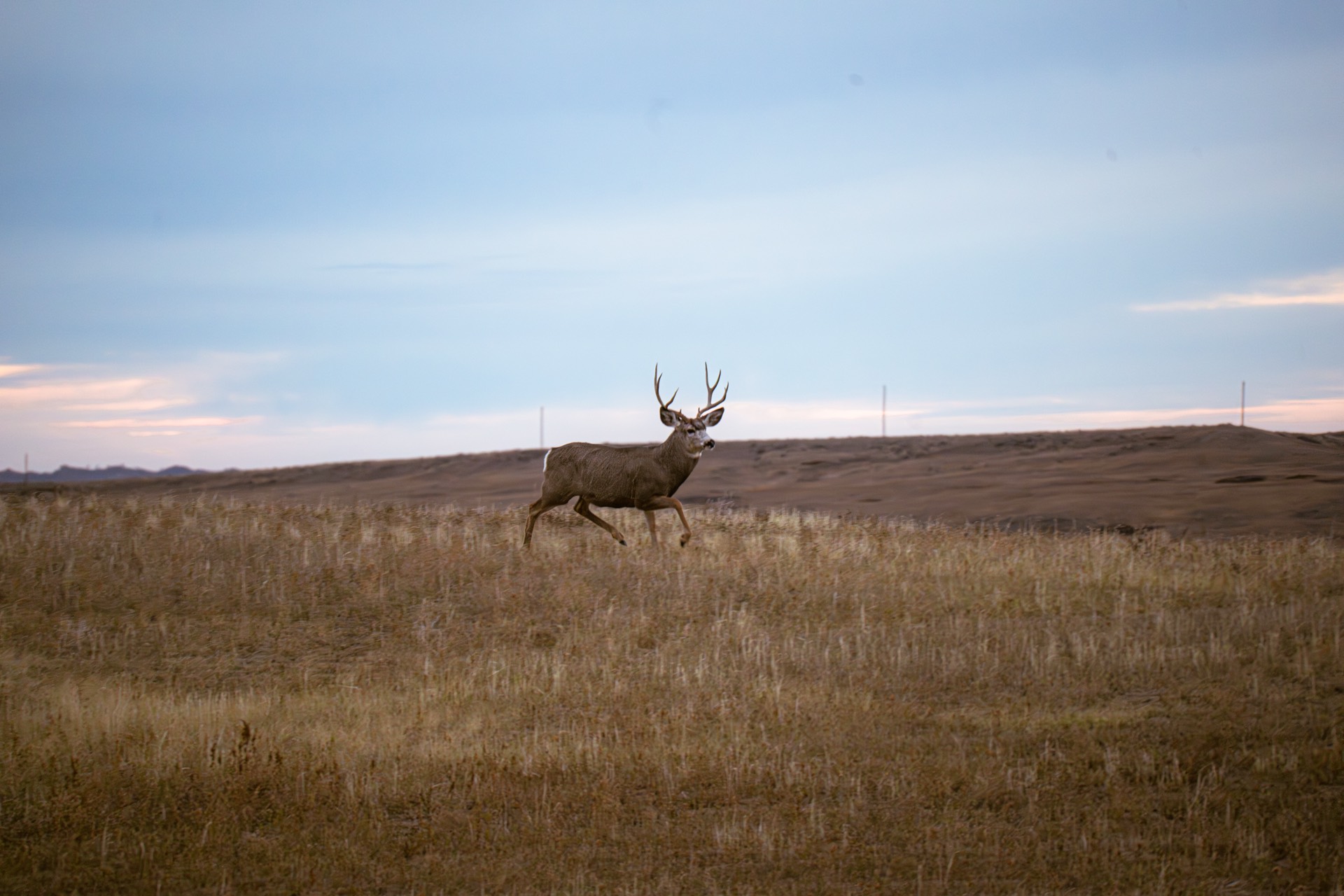
common qualityThe premier mule-deer draw in District 2 — about 93% of the buck harvest is mule deer, with a ~29% modern-firearm success rate, and herds near their long-term average. A 3-point minimum applies. Terrain favors modern-firearm and muzzleloader hunters over archers.
- →Glass the scabland buttes, coulee rims, and bitterbrush pockets at first and last light
- →Hunt the edge where wheat stubble meets untillable scabland — bucks feed the ag and bed in the rocks
- →Work the Swanson Lakes / Twin Lakes public scabland complex on foot, then push into HBWP wheat ground for bigger bucks
- →Use muzzleloader or modern-firearm seasons; the open terrain is tough for archery stalks
Whitetail Deer
limited opportunityWhite-tailed deer are a small minority of the harvest (~7%), tucked into the riparian and wetland corridors that thread the scablands. A 3-point minimum applies and the late season is permit-only (Palouse Special Permit).
- →Focus on riparian brush and wetland edges along the scabland lakes and Crab Creek
- →Identify species before shooting — mulies dominate but whitetails overlap in the bottoms
Rocky Mountain Elk
limited opportunityElk of the Selkirk / Spokane sub-herd are scattered and highly mobile in the scablands; the general season is 'any elk' but numbers are low and finding them is the challenge.
- →Cover country and chase fresh sign or damage sightings
- →Lean on private-land access — elk are rarely on the public scabland long
- →Treat elk as a bonus tag rather than a target species here
Black Bear
limited lowThe Columbia Basin lacks the forested habitat for resident black bears; GMU 136 harvest is very low to nonexistent and WDFW does not consider it worthwhile to target.
- →Not a realistic bear unit — expect at most an incidental encounter
Pro tips
- →This is the district's best mule-deer unit AND has the most public ground — start with the Swanson Lakes WLA and adjacent Twin Lakes/Telford BLM before burning access favors.
- →Hunt the wheat-to-scabland edge: bucks feed the stubble at night and bed in the basalt coulees by day.
- →Sharp-tailed grouse on Swanson Lakes are a protected species — do NOT shoot them; mule deer, quail, and gray partridge are the legal targets there.
- →Coffeepot Lake is a no-hunting refuge — know the boundary.
- →Skip archery for the open scabland; muzzleloader and modern firearm fit the glassing-and-stalking-flat terrain far better.
Watch out for
- !Even at 11% public, the majority is private wheat ground — respect boundaries; WDFW Enforcement monitors enrolled access land.
- !Columbian sharp-tailed grouse (state threatened) are common on Swanson Lakes and NOT legal to hunt — misidentification risks a citation.
- !Coffeepot Lake is closed to hunting.
- !CWD surveillance is active in GMUs 101–186; carcass-transport rules apply.
- !Scabland has little water and no services off the highways; roads turn to gumbo when wet.
Logistics
Harrington, Odessa, Wilbur, and Creston offer fuel, groceries, and basic lodging; Spokane is about 60–75 minutes east for full resupply. Camping is available on BLM scabland (Twin Lakes, Telford) and near Swanson Lakes. Cell coverage is patchy off the highways. Water is scarce on the scabland — pack your own.
Nearest towns: Harrington, Odessa, Wilbur, Creston, Davenport
Seasons & regulations
This page carries no season dates or regulations. Get current rules from the official Washington sources:
Research sources: WDFW District 2 Hunting Prospects 2022 (PDF) · GoHunt — Washington Unit 136 Harrington profile · WDFW Swanson Lakes Wildlife Area Unit
FAQ
- How big is GMU 136 in Washington?
- GMU 136 (Harrington) covers about 1,579 square miles, ranging from roughly 1,500 to 2,650 feet in elevation. Area is computed from the unit boundary polygon.
- How much public land is in GMU 136?
- Approximately 11% of the unit is public land. Primary managers: WDFW Swanson Lakes Wildlife Area, BLM (Twin Lakes, Telford, scabland tracts — ~60,000 ac WDFW/BLM in central Lincoln Co.), Private dryland-wheat ranches, WDNR state lands. Always verify ownership boundaries on the ground.
- What species does the catalog list for GMU 136?
- Mule Deer, Whitetail Deer, Rocky Mountain Elk, Black Bear. For seasons, tags, and regulations, use the official Washington agency resources linked on this page — this page carries no regulatory information.
Put GMU 136 on your map.
Boundary lines, public/private ownership, topo, and offline maps for this unit — in Baseline Maps, free for 14 days.