GMU 418 Nooksack
Nooksack: North Cascades trophy-bull elk (permit-only), a top District 14 bear unit, and rugged high-country blacktail under Mt. Baker.
WDFW Region 4 — North Puget Sound (District 14, Whatcom County) · Last reviewed 2026-07-12
Area
832
sq mi
Public land
55%
approx.
Elevation
200–10,781
feet
Motorized
moderate
access
Overview
GMU 418 "Nooksack" is a large (~830-square-mile) North Cascades unit filling much of Whatcom County — from the working forests of the Nooksack River valley up to the glaciers of Mt. Baker and the Canadian border. It is the core of the North Cascades (Nooksack) elk herd, offering some of the state's few permit-only, trophy-quality Roosevelt/Cascade bull-elk hunts. It is also District 14's single best black bear unit (about 42% of the four-GMU harvest) and holds a rugged high-elevation blacktail hunt, plus tightly limited Mt. Baker mountain-goat permits. Land is a stack of Mt. Baker-Snoqualmie National Forest, Mt. Baker Wilderness, North Cascades National Park, DNR, and private industrial timber (notably Sierra Pacific Industries).
Terrain
One of the most vertical units in the state: from ~200-ft valley bottoms along the Nooksack and its forks up through mid-elevation working forest to alpine ridges, glaciers, and the 10,781-ft summit of Mt. Baker. Lower elevations are logging-road-accessible working forest; the upper unit is trailhead-and-boot wilderness with heavy snow and glaciated peaks.
Cover: Lowland and montane Douglas-fir/western hemlock/western redcedar working forest with alder bottoms and berry-rich clearcuts and regen at low and mid elevation; silver fir and mountain hemlock climbing to subalpine parkland, heather meadows, and alpine rock and ice up high.
Landmarks: Mt. Baker (10,781 ft) & Mt. Baker Wilderness · North Fork, Middle Fork & South Fork Nooksack River · Baker Lake and Lake Shannon (east boundary) · Mt. Baker National Recreation Area · North Cascades National Park (east/south) · Highway 542 (Mt. Baker Highway) and Highway 20 (North Cascades Highway, south boundary) · Highway 9 (west boundary) / Acme–Sedro-Woolley corridor · Canadian border (north boundary)
Access
Access is a two-tier system. High/mid country is public: Mt. Baker-Snoqualmie NF and DNR working forest give extensive walk-, bike-, and drive-in access via logging mainlines and trails — but watch for seasonal and fire closures and check the Mt. Baker-Snoqualmie NF Road & Trail Conditions map. Lower valley and foothill forest is heavily private industrial timber and DNR; WDFW's Private Lands Access Program has partnered with Sierra Pacific Industries to open its GMU 418 lands specifically to drawn GMU 418 elk special-permit holders (WDFW sends access details to permit holders). Elk hunters should concentrate on the core elk area bounded roughly by Acme east to Baker Lake (north), the west shores of Baker Lake/Lake Shannon to Highway 20 (east), Highway 20 to Highway 9 (south), and Highway 9 from Sedro-Woolley to Acme (west). E-bikes count as motorized and are limited to roads/trails open to motor vehicles — confirm with each landowner. GMUs 418/426 sit inside a federally designated grizzly-bear recovery area, so bear hunters MUST pass WDFW's annual online bear-identification exam (80%+) and carry proof afield.
Managers: USFS Mt. Baker-Snoqualmie National Forest, Mt. Baker Wilderness (USFS), North Cascades National Park / Ross Lake NRA (NPS), WA DNR, Sierra Pacific Industries, Private timber & valley landowners
Access points: Highway 542 (Mt. Baker Highway) via Deming, Glacier to the high country and trailheads · Highway 9 / South Fork Nooksack (Acme, Van Zandt, Wickersham) into DNR and timber roads · Baker Lake Road (off Highway 20) to the east-side core elk area and NF trailheads · Highway 20 (North Cascades Highway) along the south boundary · Mt. Baker-Snoqualmie NF logging mainlines and wilderness trailheads (walk/bike-in)
Species notes
Roosevelt Elk
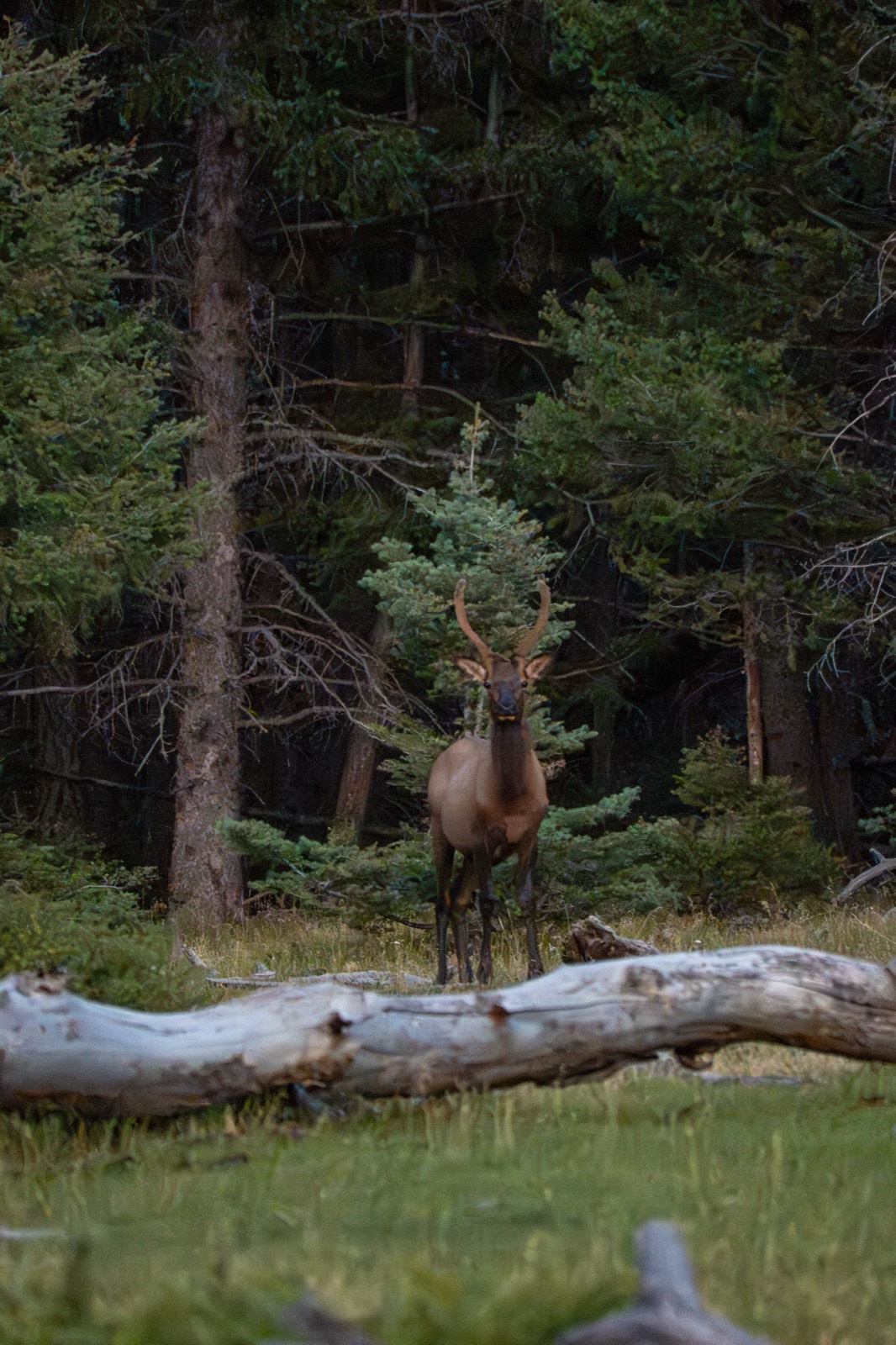
common trophyThe marquee hunt: GMU 418 is the core of the North Cascades (Nooksack) elk herd (~1,600 elk in the core area, bull:cow near 18:100). Bull elk are permit-only — about 29 GMU 418 bull permits in a recent year — and though the 2024 all-methods success dipped to 38% (11 of 29), it has historically run very high (up to 100%) thanks to light pressure and long seasons, and produces genuine trophy bulls (multiple 6-point-plus bulls taken). Expect many years of applying to draw.
- →Apply and be patient — this is a hard-to-draw, permit-only bull hunt; treat drawing as a multi-year project.
- →Once drawn, hunt the defined core elk area (Acme–Baker Lake–Hwy 20–Hwy 9 box) where herd density is highest.
- →Use the Sierra Pacific Industries PLAP access opened to GMU 418 permit holders, and lock in any additional private permission early.
- →Scout hard across the long season; glass clearcuts, forage openings, and river-bottom edges, and be ready to work timber for bedded bulls.
- →Consult the Mt. Baker-Snoqualmie NF road/trail conditions for gate status before committing to a drainage.
Black Bear
abundant qualityDistrict 14's standout bear unit. A 2021 WDFW hair-snare study estimated ~28 bears per 100 km2 in GMU 418, and about 42% of the four-GMU (407/418/426/437) bear harvest came from 418 in 2024. Berry-rich clearcuts and regen in the working forest make for excellent spot-and-stalk bear hunting — but note the grizzly recovery-area bear-ID exam requirement.
- →Pass the WDFW bear-identification exam (80%+) and carry proof — mandatory in the 418/426 grizzly recovery area.
- →Glass berry-rich clearcuts and regen stands (huckleberry, salmonberry, blackberry) at dawn and dusk in early fall.
- →Hunt the open cut units so you can spot a bear before it winds you in the thick coastal cover.
- →Find a productive feeding cut with fresh sign and sit it patiently rather than covering ground.
- →Work the logging-road network for glassing vantages, and know your bear ID cold — grizzlies are protected here.
Blacktail Deer
common qualityColumbian black-tailed deer are present throughout, though WDFW notes valley/foothill densities in 418 have trended down. The unit's signature deer experience is the rugged high-country hunt: the September 15–25 High Buck Hunt in the Mt. Baker Wilderness for a remote, trophy-caliber blacktail, plus a permit-only late-season quality-buck hunt during the rut (low success, ~12% in 2024, but shots at mature bucks).
- →For the High Buck Hunt, be fit and self-reliant — hunt small alpine basins and lightly forested ridges away from main trails; crowds are common even miles in.
- →Glass subalpine parkland and heather benches at first and last light for bucks summering high.
- →In the working forest, hunt clearcut/regen edges and river-bottom cover at low light.
- →Chase the late-season quality-buck permit for rut movement, but keep expectations realistic on success.
- →Check NF road/trail conditions and the Noisy-Diobsud Wilderness boundary (NOT open to the High Buck Hunt) before you go.
Cougar
common opportunityCougars occur throughout the unit and are managed under a harvest cap (recently 6 cougars in GMU 418). Most are taken opportunistically by deer, elk, and bear hunters. The cap-managed season can close mid-season, so verify status via the WDFW cougar hotline or webpage before and during your hunt.
- →Carry a cougar tag as an opportunistic add-on while hunting deer, elk, and bear.
- →Check the cougar hunt-area status regularly — cap-managed units close once the cap is hit (updated weekly).
- →Hunt where deer and elk concentrate; cougars follow the prey.
- →After fresh snow at mid/high elevation, cut logging roads and trails for tracks to follow up.
Mountain Goat
limited trophyMt. Baker's flanks in GMU 418 hold mountain goats hunted under a handful of tightly limited special permits split among small hunt areas (e.g., Chowder Ridge, Lincoln Peak, Avalanche Gorge). Populations on Mt. Baker have been declining in recent years and permits are scarce (sometimes zero for a given unit), so this is a once-in-a-lifetime, draw-and-pray alpine hunt.
- →Apply for the limited Mt. Baker goat permits and expect very long odds; treat a tag as once-in-a-lifetime.
- →If drawn, prepare for serious alpine mountaineering — glaciers, exposure, and technical approaches near Mt. Baker.
- →Scout survey areas and glass high cliff-and-meadow goat habitat well before the season.
- →Watch WDFW goat-population updates — Mt. Baker numbers have been declining and permit levels reflect it.
Pro tips
- →The bull-elk hunt is permit-only and hard to draw — plan for many years of applications for a shot at a trophy North Cascades bull.
- →Drawn GMU 418 elk permit holders get WDFW-arranged access to Sierra Pacific Industries lands — use it, and focus the core elk box (Acme–Baker Lake–Hwy 20–Hwy 9).
- →418 is District 14's best bear unit — glass berry cuts at dawn/dusk, but pass the bear-ID exam first (grizzly recovery area).
- →For deer, the Mt. Baker Wilderness High Buck Hunt (Sept 15–25) is the trophy play — be fit and get off the main trails to beat crowds.
- →Check the Mt. Baker-Snoqualmie NF Road & Trail Conditions map for gates, washouts, and fire closures before every trip.
- →Mountain-goat permits here are scarce and once-in-a-lifetime; Mt. Baker goat numbers are declining.
Watch out for
- !Bull elk and mountain goat are permit-only — no general-season bull or goat opportunity here.
- !GMUs 418/426 are inside a federal grizzly-bear recovery area — the WDFW bear-ID exam (80%+) is mandatory and proof must be carried.
- !Lower-valley timber is gated private; without the PLAP/Sierra Pacific arrangement or landowner permission, low-elevation access is limited.
- !High country is glaciated and dangerous — Mt. Baker, wilderness terrain, and deep snow demand real mountaineering skill and fitness.
- !The Noisy-Diobsud Wilderness is NOT open to the High Buck Hunt — know that boundary.
- !Cougar season is cap-managed and can close mid-season — verify status before and during your hunt.
- !Warm, dry falls bring wildfire closures on NF/DNR/timber lands, sometimes posted with little notice.
Logistics
Base out of Bellingham for full services, or the smaller foothill towns of Deming, Glacier, Maple Falls (Highway 542) and Sedro-Woolley/Concrete (Highway 9/20) for closer access to the valleys and trailheads. Highway 542 climbs to the Mt. Baker high country and NF trailheads; Baker Lake Road (off Highway 20) reaches the east-side core elk area; Highway 9 and the South Fork corridor open the west-side timber and DNR ground. Mt. Baker-Snoqualmie NF offers developed and dispersed camping and trailhead access, but check the NF Road & Trail Conditions map for gate status, washouts, and seasonal or fire closures before committing. Lower-valley timberland is gated private — arrange access (e.g., the Sierra Pacific PLAP program for drawn elk hunters) ahead of time.
Nearest towns: Bellingham, Deming, Glacier, Maple Falls, Sedro-Woolley, Concrete
Seasons & regulations
This page carries no season dates or regulations. Get current rules from the official Washington sources:
Research sources: WDFW 2025 District 14 Hunting Prospects — GMU 418 elk permits/success, bear density study & harvest, High Buck & quality-buck deer, cougar cap, Mt. Baker goat, Sierra Pacific PLAP, grizzly recovery bear-ID exam · WDFW North Cascades (Nooksack) Elk Herd Plan (herd size, bull ratios, permit hunts) · GoHunt — Washington Unit 418 Nooksack profile (terrain, land ownership, access) · Mt. Baker-Snoqualmie National Forest (public land, roads, wilderness, recreation)
FAQ
- How big is GMU 418 in Washington?
- GMU 418 (Nooksack) covers about 832 square miles, ranging from roughly 200 to 10,781 feet in elevation. Area is computed from the unit boundary polygon.
- How much public land is in GMU 418?
- Approximately 55% of the unit is public land. Primary managers: USFS Mt. Baker-Snoqualmie National Forest, Mt. Baker Wilderness (USFS), North Cascades National Park / Ross Lake NRA (NPS), WA DNR, Sierra Pacific Industries, Private timber & valley landowners. Always verify ownership boundaries on the ground.
- What species does the catalog list for GMU 418?
- Roosevelt Elk, Black Bear, Blacktail Deer, Cougar, Mountain Goat. For seasons, tags, and regulations, use the official Washington agency resources linked on this page — this page carries no regulatory information.
Put GMU 418 on your map.
Boundary lines, public/private ownership, topo, and offline maps for this unit — in Baseline Maps, free for 14 days.